
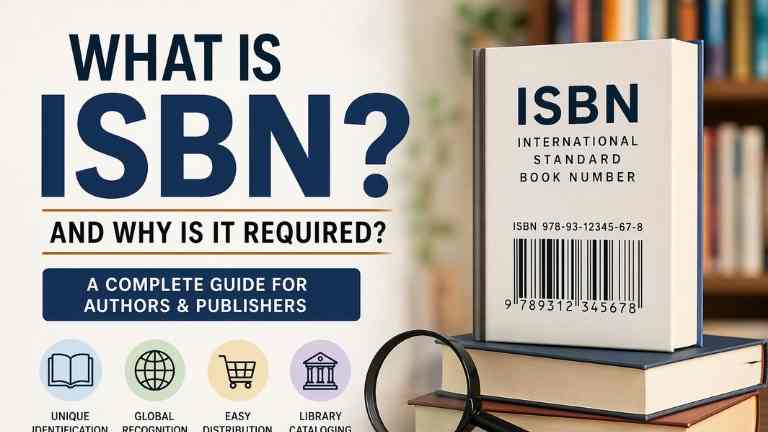
In the world of publishing, one term you will frequently come across is ISBN. Whether you are an aspiring author, a self-publisher, or a publishing house, understanding ISBN is crucial. It not only helps in identifying books globally but also plays a vital role in distribution, sales, and credibility.
In this detailed SEO-friendly guide, we will explore what ISBN is, its structure, importance, benefits, and how to get one in India.
What is ISBN?
ISBN stands for International Standard Book Number. It is a unique 13-digit number assigned to books and similar publications. This number acts like a fingerprint for a book, ensuring that each edition and format (hardcover, paperback, eBook) is uniquely identifiable worldwide.
An ISBN helps publishers, bookstores, libraries, and online platforms easily locate and manage books in their systems.
Example of an ISBN
A typical ISBN looks like this:
978-93-12345-67-8
It may seem like a random set of numbers, but each part has a specific meaning.
Structure of ISBN (13-digit Format)
The ISBN is divided into five parts:
- Prefix Element – Usually 978 or 979
- Registration Group – Identifies country or language (e.g., 93 for India)
- Registrant Element – Identifies the publisher
- Publication Element – Identifies the specific title/edition
- Check Digit – A mathematical validation digit
This structured format ensures that no two books have the same ISBN.
Why is ISBN Required?
Many new authors wonder: Is ISBN mandatory? Technically, you can publish without it, but doing so limits your reach significantly. Here’s why ISBN is important:
1. Global Identification of Books
ISBN acts as a universal identifier. No matter where your book is sold—India, the US, or Europe—it can be easily recognized using this number.
2. Essential for Book Distribution
Most major distribution platforms like online marketplaces, bookstores, and libraries require an ISBN to list your book. Without it, your book may not be accepted.
3. Helps in Inventory Management
Retailers and distributors use ISBNs to track stock, sales, and returns. It simplifies logistics and ensures smooth operations.
4. Required for Online Selling Platforms
If you want to sell your book on platforms like Amazon, Flipkart, or global bookstores, ISBN is usually mandatory. It allows your book to be indexed and searched easily.
5. Enhances Author Credibility
Books with ISBNs appear more professional and credible. It shows that your book is officially registered and recognized.
6. Facilitates Library Cataloging
Libraries rely on ISBNs to catalog books efficiently. Without an ISBN, your book may not be included in library collections.
7. Supports Sales Tracking
ISBN helps track book sales across regions and platforms, which is especially useful for publishers and authors monitoring performance.
Is ISBN Mandatory in India?
In India, ISBN is not legally mandatory, but it is highly recommended if you want:
- Wider distribution
- Online sales
- Library inclusion
- Professional recognition
For commercial publishing, having an ISBN is practically essential.
Who Needs an ISBN?
You should get an ISBN if you are:
- An author publishing your own book
- A publisher releasing books
- A self-publisher using platforms like Kindle Direct Publishing
- An educational institution publishing study material
- A researcher publishing academic books
When Do You Need a New ISBN?
Each unique version of a book requires a separate ISBN. For example:
- Hardcover → New ISBN
- Paperback → New ISBN
- eBook → New ISBN
- Revised edition → New ISBN
This ensures clarity in tracking different formats and editions.
Benefits of ISBN for Authors and Publishers
1. Better Visibility
Books with ISBNs are easily searchable in global databases, increasing discoverability.
2. Simplified Sales Process
Retailers and distributors prefer ISBN-enabled books for easy listing and selling.
3. International Reach
ISBN allows your book to be sold worldwide without confusion or duplication.
4. Legal and Professional Recognition
ISBN adds legitimacy to your work and protects it from identity confusion.
5. Easy Integration with Systems
Publishing software, bookstores, and libraries use ISBNs to manage their databases.
How to Get ISBN in India?
In India, ISBNs are issued by the Raja Rammohun Roy National Agency for ISBN, under the Ministry of Education.
Step-by-Step Process:
- Visit the official ISBN India website
- Register as an author/publisher
- Fill out the application form
- Upload required documents (manuscript, cover page, ID proof)
- Submit the application
- Wait for approval (usually free of cost)
Documents Required for ISBN
- Author’s identity proof
- Book manuscript (PDF format)
- Cover page/title page
- Publisher details (if applicable)
Cost of ISBN in India
Good news for Indian authors:
ISBN is issued FREE of cost in India
This encourages writers and self-publishers to register their books without financial burden.
ISBN vs Barcode – What’s the Difference?
Many people confuse ISBN with barcodes.
- ISBN → The unique identification number
- Barcode → A scannable image derived from the ISBN
Barcodes are used in retail stores for scanning, while ISBN is the core identification.
Common Myths About ISBN
Myth 1: ISBN is only for big publishers
Reality: Even self-published authors need it.
Myth 2: One ISBN works for all formats
Reality: Each format requires a different ISBN.
Myth 3: ISBN protects copyright
Reality: ISBN does not provide copyright protection—it only identifies the book.
ISBN for eBooks – Is It Necessary?
For eBooks, ISBN is not always mandatory, especially on platforms like Kindle. However, having one:
- Improves credibility
- Helps in multi-platform distribution
- Enables library inclusion
ISBN and Copyright – Are They the Same?
No, ISBN and copyright are completely different:
- ISBN → Identifies the book
- Copyright → Protects intellectual property
You should ideally have both for full protection and recognition.
Conclusion
An ISBN is more than just a number- it is the backbone of the global publishing system. It ensures your book is identifiable, accessible, and professionally recognized across the world.
While it may not be legally mandatory in India, it is practically essential for anyone serious about publishing and selling books. From improving visibility to enabling global distribution, ISBN offers countless advantages.
If you are planning to publish a book, getting an ISBN should be one of your first steps. It is free in India, easy to obtain, and incredibly valuable for your publishing journey.
ALSO READ
ROC Filing for Pvt Ltd Company
How to File an Appeal Against Rejection of GST Registration
Mahila Samman Scheme and Sanjeevani Yojana in Delhi
Pradhan Mantri Matru Vandana Yojana