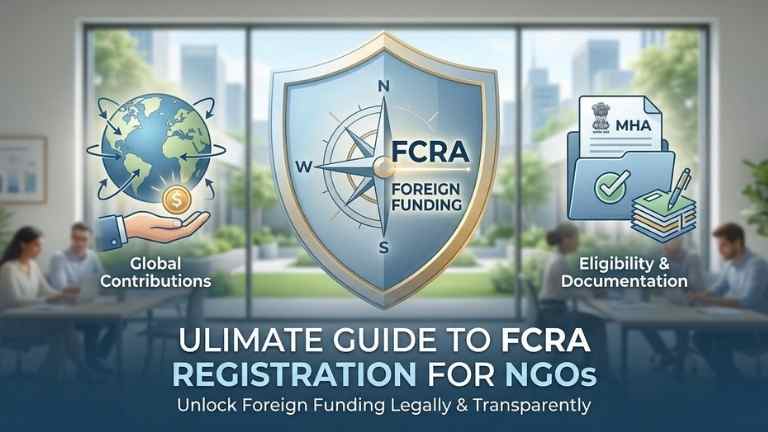
Non-Governmental Organisations (NGOs) are the backbone of social and economic development in India. While domestic contributions are crucial, accessing foreign funding can be a game-changer, allowing NGOs to scale their impact dramatically. However, bringing foreign money into India requires strict adherence to legal frameworks designed to safeguard national interests.
If your organisation plans to accept international grants or donations, securing an FCRA Registration is mandatory. This comprehensive guide will walk you through what the Foreign Contribution (Regulation) Act (FCRA) is, who needs it, and the step-by-step process to get your NGO registered.
What is Foreign Funding and the FCRA?
Foreign funding encompasses any donations, grants, or financial contributions received from foreign citizens, international corporations, or foreign governments intended for religious, educational, charitable, or developmental programs in India.
To monitor these funds and ensure they are utilised for legitimate, declared purposes, the Government of India established the Foreign Contribution Regulation Act (FCRA) of 2010. Operating without FCRA clearance when accepting overseas donations is strictly illegal.
Who Needs FCRA Registration?
Any non-profit entity—whether registered as a Trust, a Society, or a Section 8 Company—must obtain approval from the Ministry of Home Affairs (MHA) before receiving international funds.
Types of FCRA Approval
The Ministry of Home Affairs provides two distinct pathways to legally receive foreign funds, depending on the age and track record of your NGO:
1. Standard FCRA Registration. This is meant for established NGOs that have a proven track record.
- Validity: 5 years (requires renewal afterwards).
- Requirement: The NGO must have been active for at least 3 years and must have spent a minimum of ₹15 lakhs on its core objectives during that period.
2. Prior Permission This route is ideal for newly formed NGOs that do not yet meet the 3-year or financial thresholds for standard registration.
- Requirement: Approval is granted for a specific, predefined amount from a specific foreign donor for a particular project. It cannot be used to collect general pool donations.
Eligibility Criteria for Standard FCRA Registration
Before filing your application, ensure your NGO meets these strict prerequisites:
- Legally registered under the Indian Trusts Act, Societies Registration Act, or as a Section 8 Company.
- Active operations for a minimum of 3 years.
- A demonstrable track record of activities in the cultural, economic, educational, religious, or social sectors.
- Absolutely no involvement in any political campaigns or activities.
- Proof of spending at least ₹15 lakhs over the last 3 years on core activities (excluding administrative expenses).
Essential Documents Required
Having your paperwork in order will prevent application rejections. You will generally need:
- The NGO’s Registration Certificate, Trust Deed, or Memorandum of Association (MOA).
- The NGO’s PAN Card.
- NGO Darpan ID from NITI Aayog (Mandatory).
- Audited financial statements for the previous 3 financial years.
- Activity reports detailing projects executed over the past 3 years.
- Details (PAN, Aadhaar, etc.) of all key board members or functionaries.
- 12A and 80G Registration Certificates.
- A commitment letter from the foreign donor (only applicable if applying for Prior Permission).
Step-by-Step FCRA Registration Process
Step 1: Obtain a NITI Aayog Darpan ID Before anything else, your NGO must be registered on the Darpan portal to get a unique ID.
Step 2: Open an FCRA Bank Account. Under the latest government mandates, all foreign contributions must be received in a designated “FCRA Account” opened exclusively at the State Bank of India (SBI), New Delhi Main Branch.
Step 3: Compile and Digitise Documents. Gather all the mandatory documents listed above and ensure they are scanned clearly for upload.
Step 4: File the Online Application. Navigate to the official FCRA portal (fcraonline.nic.in). Fill out Form FC-3A if you are applying for standard registration, or Form FC-3B for Prior Permission. Upload the documents and pay the requisite government fees.
Step 5: Review and Issuance The Ministry of Home Affairs conducts a rigorous review of your application, which often includes a background check or field inquiry by local intelligence or police authorities. Once cleared, your FCRA Registration Certificate is issued.
Post-Registration Compliance: Staying on the Right Side of the Law
Getting the registration is only half the battle; maintaining compliance is critical to avoid suspension or cancellation:
- Annual Returns: Submit Form FC-4 annually within 9 months of the financial year ending.
- Quarterly Updates: NGOs must upload details of foreign funds received and utilized on the FCRA portal every quarter.
- Fund Separation: Never mix foreign contributions with domestic funds. Keep accounting entirely separate.
- Timely Renewal: Apply for FCRA renewal at least 6 months before your current certificate expires.
Important Recent Amendments to FCRA Rules
The government frequently tightens FCRA rules to enhance transparency. Key recent changes include:
- Mandatory SBI Account: Funds can only land in the SBI New Delhi Main Branch account.
- Capped Administrative Expenses: NGOs cannot use more than 20% of foreign funds for administrative overheads (reduced from the earlier 50% limit).
- No Sub-granting: You cannot transfer foreign funds to another NGO, even if that NGO also holds an FCRA license.
- Aadhaar Requirement: Aadhaar cards are now mandatory for all key office bearers and directors.
Why Your NGO Needs FCRA Registration
- Global Reach: Unlocks access to massive international grants, CSR funds from multinational corporations, and philanthropic aid.
- Credibility: An FCRA license acts as a strong badge of trust, proving to both domestic and international donors that your NGO is compliant and transparent.
- Institutional Partnerships: Makes your organization eligible to collaborate with global bodies like the UN, WHO, and major international foundations.
Common Mistakes to Avoid
- Applying prematurely before completing the 3-year operational requirement.
- Failing to open the mandatory SBI New Delhi bank account prior to application.
- Missing statutory deadlines for filing annual FC-4 returns.
- Using foreign funds for speculative, political, or prohibited activities.
Conclusion
Registering for the FCRA is a fundamental legal requirement for any Indian NGO looking to expand its horizons with foreign funding. While the paperwork is extensive and the rules are strict, the ability to access global resources can exponentially increase the good your organisation does in the world. Ensure your documentation is pristine, stay updated on the latest compliance rules, and unlock the financial support your mission truly deserves.
ALSO READ
How to File an Appeal Against Rejection of GST Registration
Pradhan Mantri Matru Vandana Yojana
How many Articles in Indian Constitution 1 to 395 download