
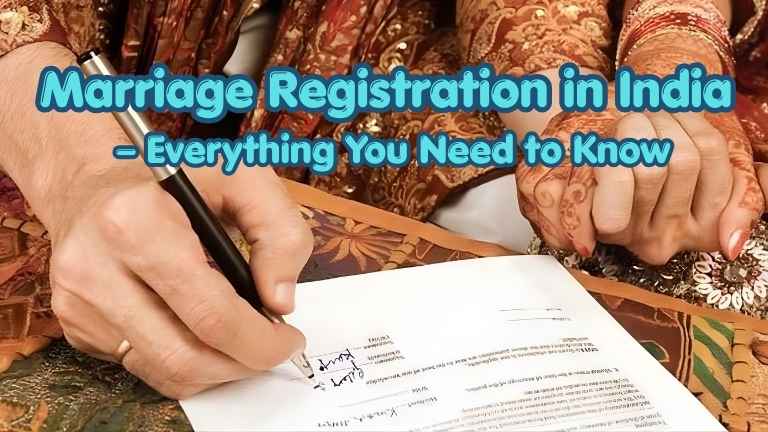
Marriage is more than just a ceremony—it’s a legal contract recognised by the government. Registering your marriage ensures it holds legal validity, making it easier to avail of spousal benefits, visas, insurance claims, inheritance, and more. Whether you had a traditional wedding or a court marriage, registration is a crucial next step.
Why Marriage Registration is Important
Marriage registration offers several legal and practical benefits:
- Provides legal proof of the relationship
- Required for visa and passport applications
- Enables name change in documents
- Helps in property and inheritance matters
- Mandatory for insurance claims and joint bank accounts
- Protects women’s rights in case of separation or dispute
Applicable Laws for Marriage Registration in India
Marriage can be registered under two specific laws:
- Hindu Marriage Act, 1955: In the event that both parties are Hindus, Jains, Sikhs, or Buddhists.
- Special Marriage Act, 1954: For marriages performed irrespective of religion or caste or civil marriages.
Who Can Register Their Marriage?
Application for registration can be done if:
- You and your spouse have a legal marriage (traditional or court)
- Either spouse is a citizen or resident of India
- They both are above the legal age of marriage (18 for brides and 21 for grooms)
Documents Required for Marriage Registration
You’ll need the following documents:
- Wedding invitation or proof of solemnization (like photographs)
- Address proof of both partners (Aadhaar, Passport, etc.)
- Age proof (Birth certificate, 10th marksheet, passport)
- Affidavit stating marital status and nationality
- Passport-sized photographs of both spouses
- Witnesses with ID and address proof (usually 2–3)
Note: Additional documents may be requested by the registrar depending on your state.
Step-by-Step Process of Marriage Registration
- Document Upload/Submission: Attach required documents and photos.
- Appointment Scheduling: Choose a date and time with the local registrar’s office.
- Verification: Appear in person with your spouse and witnesses. Verification of identity and documents is done.
- Certificate Issuance: On successful verification, the marriage certificate is issued—either the same day or within a few days.
Timeframe and Fees
- Time Required: 1–30 days, depending on the law (Hindu vs. Special Marriage Act) and local workload.
- Fees: Registration charges vary between ₹100 and ₹500, depending on the state. Extra charges may apply for Tatkal services.
Tatkal Marriage Registration
For urgent needs like visa processing, some states allow Tatkal registration for faster certificate issuance—usually within 1–2 working days. This often requires a slightly higher fee and a valid justification.
Marriage Registration for NRIs and Foreigners
Marriages in India can be registered under the Special Marriage Act even in cases where one spouse is a foreign national or an NRI. However, besides the usual documents, one will also have to provide a No Objection Certificate (NOC) from the foreign embassy and hold a valid visa.
Digital Marriage Certificates and e-Registration
Many states offer online portals for:
- Application submission
- Appointment booking
- Payment of fees
- Downloading e-certificates
Why Choose KCorp Tax for Marriage Registration?
Marriage registration can be complex—especially if you’re dealing with inter-caste, inter-religious marriages, or urgent timelines. That’s where KCorp Tax comes in.
- End-to-end service – From document verification to appointment scheduling and follow-up
- PAN India support – We help you in any state or UT across India
- Tatkal & NRI assistance – Fast-tracked services for urgent or cross-border registrations
- Legal experts on call – Ensure you meet all the compliance requirements
Let us handle the paperwork while you enjoy your marital bliss.
Get Your Marriage Registered Stress-Free with KCorp Tax
Marriage registration is an important milestone—make it hassle-free with KCorp Tax. Our team of legal experts, documentation specialists, and field coordinators handle the entire process for you, whether it’s a local registration or a complex interfaith or NRI marriage case.
Contact us today for a free consultation and step-by-step assistance.
Let KCorp Tax be your trusted legal partner in building your future—starting with your marriage certificate.
FAQs on Marriage Registration
1. Is it mandatory to register a marriage in India?
Yes, as per Supreme Court directives, marriage registration is legally required. It ensures proof of marriage in the eyes of law and protects both spouses’ rights. It’s essential for visa applications, property claims, or legal disputes. Failure to register can cause complications in future legal matters.
2. Can I register my marriage online?
You can initiate the process online through your state’s registration portal. However, both spouses and witnesses must visit the registrar physically. This step is necessary for identity, signature, and document verification. Online booking helps avoid long queues and speeds up the process.
3. What is the difference between the Hindu and the Special Marriage Act?
The Hindu Marriage Act is for Hindus, Jains, Buddhists, and Sikhs only. The Special Marriage Act allows interfaith or civil marriages without conversion. It includes a 30-day notice period and is conducted in the court’s presence. Special Marriage also involves more paperwork and public objections.
4. How many witnesses are required?
Two witnesses are required for the Hindu Marriage Act registration. For the Special Marriage Act, you need three witnesses present. All witnesses must carry valid ID and address proof documents. They must sign during the registration process at the registrar’s office.
5. Can we register a marriage after many years?
Yes, marriage registration is possible years after the actual ceremony. You’ll need proof like wedding cards, photos, and witness declarations. The registrar may ask for affidavits validating the marriage date. It’s never too late to legally recognise your marriage in India.
6. What happens if I lose my marriage certificate?
You can apply for a duplicate marriage certificate from the registrar. This may involve submitting an application and supporting documents. Some states allow downloading it from their official online portal. The duplicate holds the same legal value as the original certificate.
7. Is Aadhaar mandatory for marriage registration?
Aadhaar isn’t legally compulsory but is commonly requested by registrars. It serves as a reliable address and identity proof in most Indian states. Other ID proofs like a passport or a voter ID, may also be accepted. Check with your local registrar’s office for accepted documentation.
8. Can NRIs register their marriage in India?
Yes, NRIs can register under the Special Marriage Act in India. They’ll need additional documents like passport, visa, and an NOC. The marriage must follow proper legal steps and document verification. Legal help is recommended to handle jurisdictional and embassy matters.
9. Can the marriage certificate be used abroad?
Yes, it’s valid worldwide once attested or apostilled as per requirement. You can use it for spouse visas, green card, or residency applications. It must be issued by a government-recognised registrar to be valid. Foreign embassies may also ask for translation in their local language.
10. Is court marriage different from marriage registration?
Yes, court marriage is a type under the Special Marriage Act. It includes solemnization and registration on the same day or process. Marriage registration, however, records any legally conducted marriage. It could be religious or traditional but still needs official recording.
11. Can interfaith marriages be registered easily?
Yes, they can be registered under the Special Marriage Act. A 30-day public notice is mandatory before solemnization takes place. Documents like a birth certificate, address proof, and a passport are required. Both partners must appear before the registrar with witnesses.
12. Can I change my surname after registration?
Yes, you can legally change your surname post-marriage. You need an affidavit, a newspaper publication, and gazette notification. This change can then be reflected in the passport, Aadhaar, etc. Your lawyer or service provider can help with the paperwork.
13. Can same-sex couples register a marriage in India?
Currently, Indian law doesn’t allow legal registration of same-sex marriages. Although some states offer recognition for joint living, it lacks legal status. Petitions are being considered in courts to change this law. Till then, same-sex couples cannot obtain a marriage certificate.
14. What if my spouse is abroad?
Marriage can be registered using a Power of Attorney in some cases. One partner must be present in India for the registration process. You’ll need embassy-attested documents and legal authorisation. This is common for NRIs and requires careful planning.
15. Is it mandatory to visit the registrar in person?
Yes, both spouses and witnesses must be physically present. This is to verify documents, identity, and take photos or signatures. Online applications do not replace the physical visit for registration. Only a few exceptions are allowed under the Power of Attorney provisions.
16. Can marriage registration be done on weekends?
Most registrar offices operate only on weekdays (Mon–Fri). Some metro cities allow weekend slots with prior appointments. You must check with the local sub-registrar for such exceptions. Early bookings are advised during the festival or peak wedding seasons.
17. How long does it take to get the certificate?
Hindu Marriage Act certificates are issued in 1–3 working days. Under the Special Marriage Act, it takes at least 30 days. This delay is due to the mandatory notice and objection period. KCorp can help you track and expedite the entire process.
18. Can KCorp Tax help with urgent registration?
Yes, KCorp Tax specialises in Tatkal or emergency marriage registration. We assist in documentation, verification, and appointment setup. Same-day or 24-hour slots are possible in select cities. We also handle follow-ups with registrar offices for quick processing.
19. Is there a fine for late marriage registration?
There’s usually no official fine for late registration in India. However, older marriages require additional proof and scrutiny. Some states may charge a nominal late fee or ask for affidavits. Delays can also affect visa or legal applications in the future.
20. How do I get started with Kcorp Tax?
It’s easy—just call us or visit our website for a free consultation. We’ll review your case, documents, and recommend the best route. From paperwork to appointments, we handle everything start to finish. Enjoy a stress-free experience with expert legal assistance from KcorpTax.
ALSO READ