
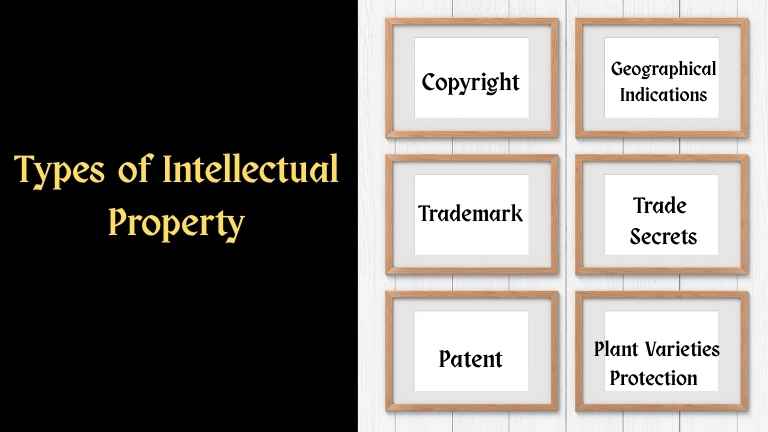
In the rapidly evolving landscape of innovation and creativity, Intellectual Property (IP) plays a pivotal role in safeguarding the rights of creators and inventors. In India, the legal framework for Intellectual Property Rights (IPR) is robust, ensuring that individuals and businesses can protect their intangible assets effectively.
1. Copyright
Copyright simply means that original works of the authorship are protected such as literary, artistic, musical, and dramatic creations. It also covers ALL kinds of goods – like books, music, movies, and even software, paintings, etc.
Governing Law: n India, the Copyright Act, 1957 is the governing law for copyright protection.
The salient features are:
- Automatic Protection: Copyright protection is available automatically at the instant of the work’s creation and registration is not required, though registration itself does furnish legal proof.
- Duration: In general, it extends through the lifetime of the author plus sixty years.
- Rights Conferred: Copyright provides the owner with the right to reproduce, distribute, perform, display, and create derivative works.
2. Trademark
Meaning: A trademark is a recognizable sign, symbol, name, or combination of those, applied to distinguish one person’s goods or services from others.
Key Takeaways:
- Registration: While not a necessity, it is advantageous for legal standing and exclusivity.
- Validity: An initial period of ten years is allowed for registered trademarks, after which they can be renewed preferably after the expiration of the other protection.
3. Patent
Definition: A patent implies relating to an inventor having full rights to a new, unusual, industrially usable invention.
Key Features:
- Right Conferred: It includes the right of a patentee to prevent others from making, using, selling, or importing the patented invention without the patentee’s consent.
- Path to Application: Consist of an intricate examination of whether the invention satisfies the criteria of novelty, inventive step, and industrial applicability
4. Geographical Indications (GI)
Definition: Geographical Indications are signs used on products that have a specific geographical origin and possess qualities or a reputation due to that origin.
Governing Law: The Geographical Indications of Goods (Registration and Protection) Act, 1999 governs GI protection.
Key Features:
- Instances comprise: Chai, Basmati rice, Kanpur silks.
- Safeguarding: This implies that no unauthorized people can use either GI tag thereby preventing misuse or degradation of the good name of the product
- Term: The registration of GIs is valid for a period of ten years and can be further renewed.
5. Trade Secrets
Definition: Trade secrets are private economic data comparable to formulas, practices, processes, or designs, affording the competitive advantage.
Applicable Law: India does not have a Trade Secret Act but it can protect any trade secret under contract and equity principles.
Key Features:
- Protection Mechanism: Maintained through confidentiality agreements and internal security measures.
- Duration: Indefinite, as long as the information remains confidential.
- Legal Recourse: Breach of confidentiality can lead to legal action for damages.
6. Plant Varieties Protection
Definition: Protects new, distinct, uniform, and stable plant varieties developed through breeding.
Governing Law: For those concerned, the Protection of Plant Varieties and Farmers’ Rights Act (PPV&FR Act) 2001 constitutes a relatively recent law (Seeds Act 1966).
Key Features:
- Rights Granted: Breeder exclusive rights over the reproduction, selling, and marketing or distribution of the plant variety.
- • Duration: Different and between 15 to 18 years depending on the type of plant.
Importance of Intellectual Property Rights
- Encourages Innovation: By granting exclusive rights, IPR incentivizes creativity and technological advancement.
- Economic Growth: IP assets can be monetized, contributing to economic development.
- Brand Protection: Trademarks and designs help in building brand identity and consumer trust.
Filing and Managing Intellectual Property in India
Registering and managing IP rights in India has become more streamlined with digital portals provided by the Controller General of Patents, Designs & Trademarks and other related bodies. Applications can be filed online for patents, trademarks, and designs. The Indian government also supports startups and MSMEs by offering fast-track processing, subsidies, and expert assistance through IPR facilitation centers.
You can monitor the status of your IP application, submit responses to objections, pay renewal fees, and download certificates online, making the process transparent and efficient.
Importance of IP Awareness
In today’s competitive world, every business—whether small or large—must recognize the value of intellectual property. Understanding the types of intellectual property in India helps creators, entrepreneurs, researchers, and artists to:
- Safeguard their work and ideas from misuse.
- Build business credibility and brand identity.
- Secure funding and licensing opportunities.
- Prevent legal disputes with other businesses or individuals.
Having knowledge of IP laws also ensures that you do not accidentally infringe on someone else’s rights.
Common Mistakes to Avoid in IP Protection
Even though the IP system in India is comprehensive, many people make avoidable mistakes:
- Not registering a trademark or design, thinking it’s not necessary.
- Disclosing inventions publicly before applying for a patent, which leads to loss of novelty.
- Failing to renew registered IP rights, which leads to expiration.
- Not using legal agreements to protect trade secrets when dealing with partners or employees.
- Assuming that copyright or trademark rights are internationally valid (they’re jurisdiction-specific unless registered globally).
Being cautious and well-informed is key to maximizing the value of your intellectual property.
Conclusion
Intellectual Property in India is a valuable asset in the modern knowledge-driven economy. Whether you’re a startup innovator, a traditional artisan, a business owner, or a content creator, understanding and securing your IP rights is crucial to protecting your efforts and growing your brand. The various types of intellectual property in India—including copyright, trademarks, patents, designs, GIs, trade secrets, and plant variety protections—each serve a unique purpose and come with specific benefits and legal frameworks.
With increasing government support, digital infrastructure, and global awareness, India is on a promising path toward becoming an IP-driven economy. But the first step lies in being informed—and taking action to protect your rights.
FAQs
1. What is the process for registering a trademark in India?
To register a trademark, one must file an application with the Trademark Registry, including details of the mark and the goods/services it represents.
2. Can software be patented in India?
In India, software per se is not patentable. However, if the software has a technical application or is embedded in hardware, it may qualify for patent protection.
3. How can one protect a trade secret in India?
Protection is achieved through confidentiality agreements, internal policies, and legal contracts that prevent unauthorized disclosure or use of sensitive information.
4. What is the significance of Geographical Indications?
GIs protect products that have a specific geographical origin, ensuring that only authorized users can use the GI tag, thereby preserving the product’s reputation and authenticity.
6. How long does copyright protection last in India?
Generally, copyright lasts for the lifetime of the author plus 60 years. For certain works like films and sound recordings, the duration is 60 years from publication.
7. Is it mandatory to register a design in India?
Certainly! Here’s the continuation and completion of the 1500-word article on “Types of Intellectual Property in India” with the remaining part of the article, including FAQs and conclusion:
7. Is it mandatory to register a design in India?
Yes, to get legal protection for an industrial design in India, registration is mandatory. Without registration under the Designs Act, 2000, the creator cannot claim exclusive rights or take legal action against imitators.
8. Can a trademark be renewed?
Yes, a registered trademark in India is valid for 10 years and can be renewed indefinitely for further periods of 10 years each by paying the prescribed renewal fees before expiry.
9. What is the difference between a copyright and a trademark?
Copyright protects creative works like books, music, and art, whereas a trademark protects brand names, logos, and slogans that distinguish goods/services in the market. Both offer exclusive rights but apply to different types of intellectual property.
10. What happens if someone violates my Intellectual Property Rights?
If someone infringes your intellectual property rights in India, you can initiate legal proceedings in civil or criminal courts. Remedies may include compensation, injunction (stopping further use), seizure of goods, and even imprisonment in some cases.
How to Login to the GST Portal
How to Get GST Number for Meesho Sellers